FlashForge AD5X Review: Six Weeks With a Four-Color 3D Printer
Four spools, one nozzle. Six weeks with FlashForge's AD5X: what the speed and the color changes are actually like — plus the stuff most reviews skip.
It started with a broken drawer knob. It wasn't worth a repair call, the hardware store didn't have the right one, and the manufacturer wanted eleven days and a shipping fee for a part that probably costs them 40 cents. A friend printed me a replacement in about twenty minutes — in bright orange, because that was the spool already loaded — and I finally understood why people get obsessed with these machines.
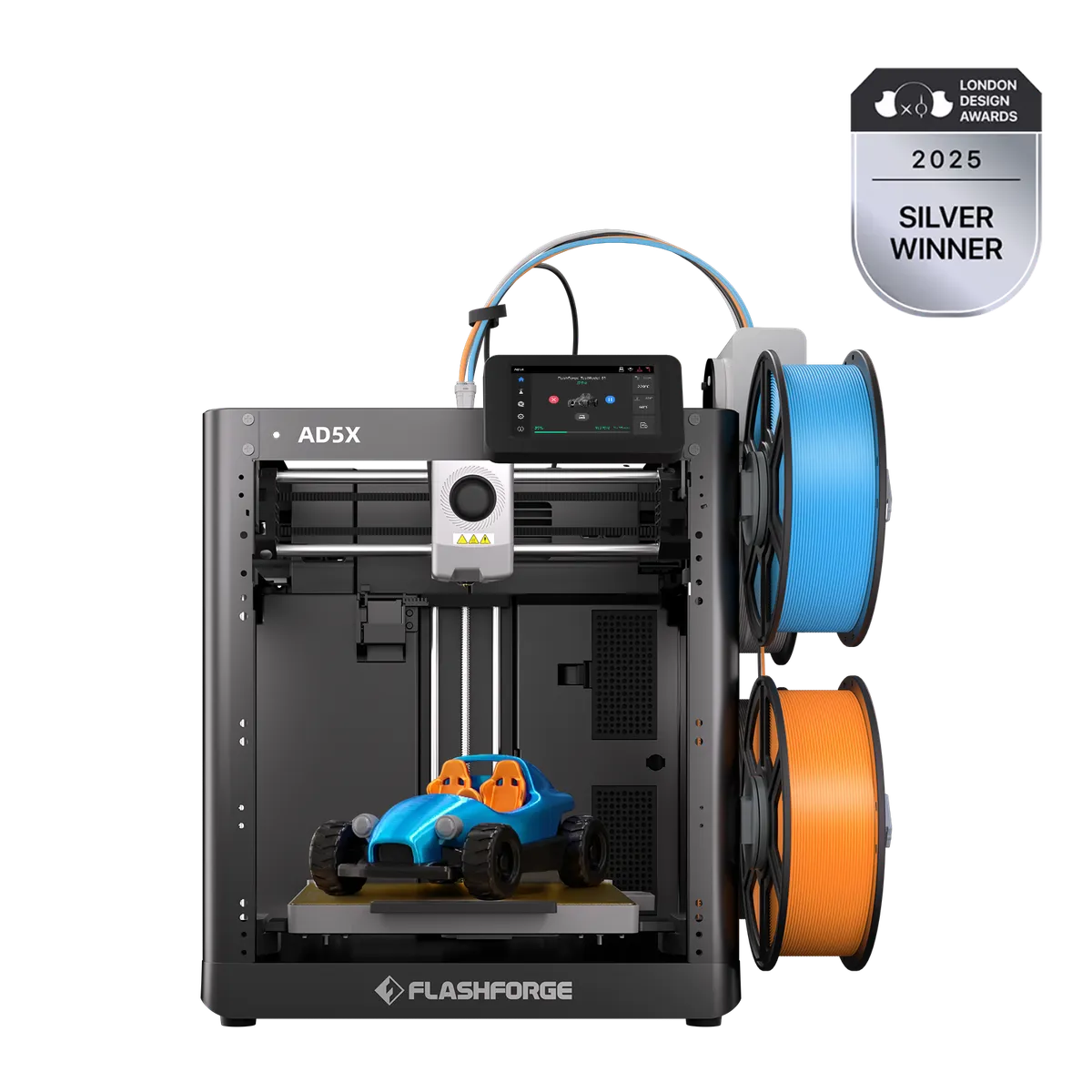
Six weeks ago the FlashForge AD5X moved onto the side table by my bookshelf, and that knob is now the least interesting thing it has produced. For the uninitiated: the AD5X is a four-color printer. Four spools feed one nozzle, so a two-tone planter or a batch of color-coded drawer labels prints in one go, no hand-swapping filament. It's fast — FlashForge quotes 600 mm/s and 20,000 mm/s² of acceleration, numbers that mean as little to you reading this as they did to me before I bought one — it levels its own bed, and it sells for $349, down from a $499 list price. It also took silver at the 2025 London Design Awards, and that part I believe. This is a machine that looks good sitting in a room, which counts for more than it should when the machine is going to live in your apartment.
Setup takes an afternoon, not a weekend
Out of the box, the printer is mostly assembled. You set up the spool rack and the screen, tighten a few screws, plug the four filament tubes into the switcher, and let it probe its own bed while you pick a filament preset. My first print — a calibration cube, because of course — came off clean, and setup took under an hour including the part where I read every instruction twice.
The real learning curve isn't the hardware, it's the software. FlashForge ships two slicers: FlashPrint, which is friendly and a little basic, and Orca-Flashforge, a full Orca Slicer with the FlashForge logo on it. I used FlashPrint for a week and switched once I wanted serious control over supports. If you've used any slicer before, skip straight to Orca.
The textured PEI plate: PLA releases on its own once the plate cools.
What four colors actually gets you
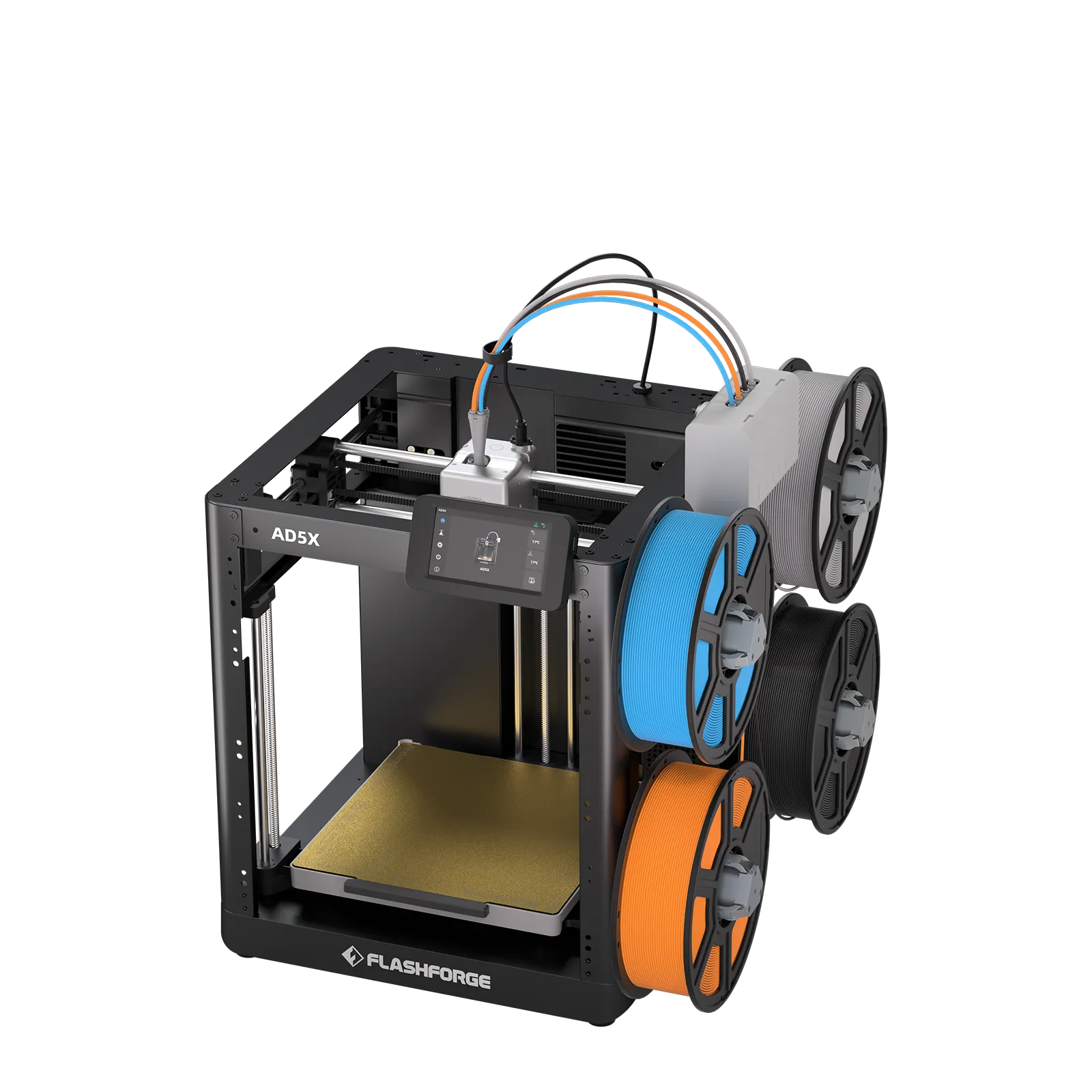
Here's the part nobody explains clearly. The AD5X has a single nozzle — colors don't mix in the print head. Each color change purges the old filament and loads the next, and the purged plastic gets dropped into a small "purge tower" beside your print. One simple switch, almost no tower. A print that cycles colors every few layers quietly builds a plastic monument next to itself. Worth knowing before your first rainbow attempt.
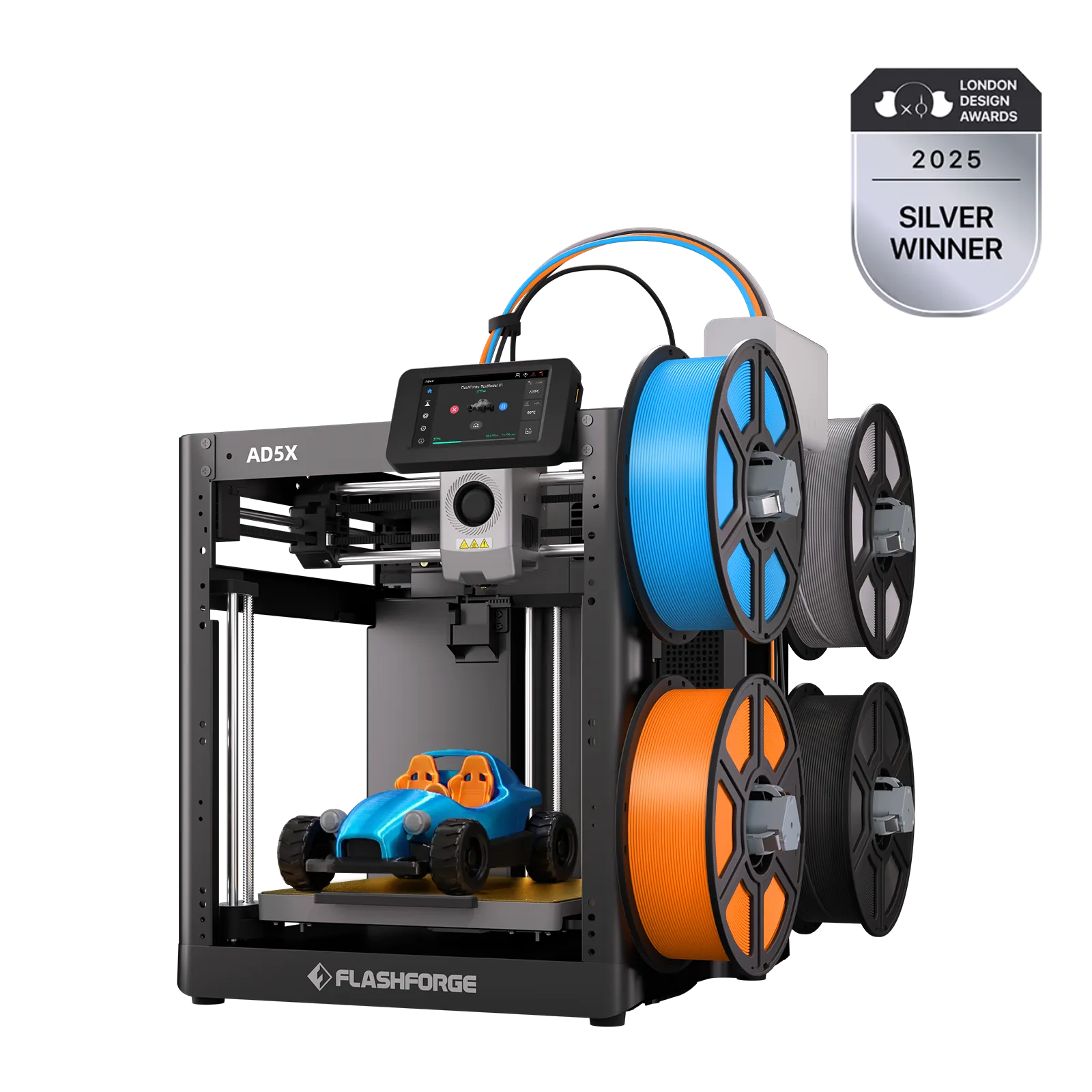
Four spools, one nozzle. The color switching happens out of sight — the waste tower is the visible tax.
The trick every owner learns in week one is to put color changes on the vertical axis. Flat things — signs, magnets, coasters, keychains — switch color once or twice and waste almost nothing, and they look genuinely custom. It's also why the boring truth is that most of my printing is single-color: the utility prints don't need paint. But the four-color ones are what gets texted to friends, and when a small print finishes in about the time it takes to make coffee, that's an easy trade.
Living with it
Let's be honest about the noise. The AD5X is not silent — it's a low mechanical hum with a fan note on top. Fine for a living room, noticeable on a video call. I stopped hearing it in two weeks. My meeting attendees did not.
The footprint is small-microwave territory: about 36 cm wide before spools, a touch over 40 with all four loaded on the side rack. And the machine is the cheap part. Your first four-spool set will nearly double the initial spend, and if you live somewhere humid, a filament dryer earns its shelf space. Stick to PLA and PETG while you're learning; they're forgiving, cheap, and print beautifully at speed. If you insist on ABS — or you have a cat that treats moving machinery as a personal challenge — FlashForge sells a clear enclosure kit that turns the open frame into an actual cabinet.
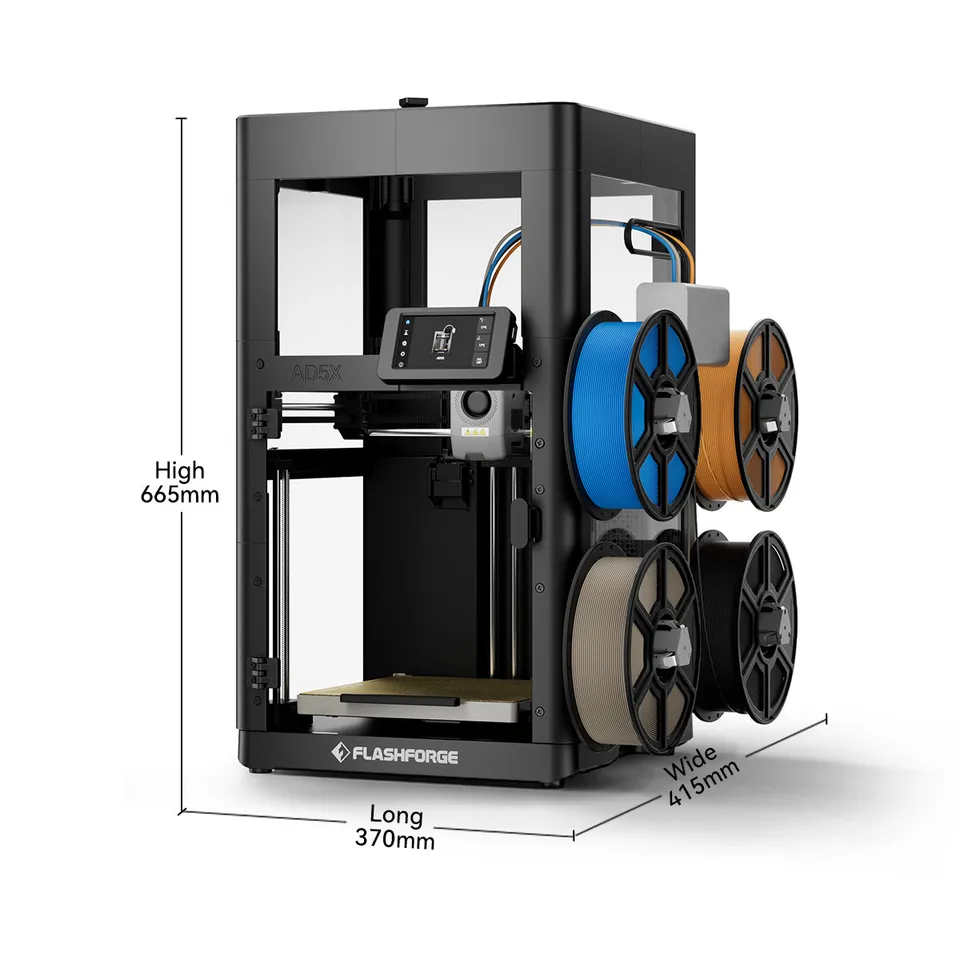
The optional enclosure kit adds about 22 cm of height and takes the AD5X from open frame to cabinet.
What I'd print first
Start with the unglamorous stuff. Custom drawer organizers that fit your actual drawers, wall hooks for keys, cable clips, a stand for the phone that currently leans against the kettle. This is the quiet magic: one small fix at a time, and they never stop showing up.
Then there are the prints you'll actually show people — monogram coasters for the coffee table, a cache pot for the plant already on your windowsill, color-blocked earrings, a name sign for a kid's door. Anything where the colors are the design comes out looking bought rather than made. In a good way.
The bottom line
Six weeks in, I'd recommend the AD5X to almost anyone printer-curious. It's the rare machine that's simple enough to set up on a Saturday and capable enough that you won't outgrow it by Christmas. The speed makes printing a background activity instead of an afternoon project, the auto-leveling means you're never fighting the bed, and the color system is genuinely useful even when most prints stay single-color.
The honest exception: if you need an enclosed machine for engineering materials from day one, this isn't it — an enclosure kit gets you partway, and past that it's FlashForge's Creator line and a different budget entirely.
At $349 — down from $499 list — it's priced like a serious machine in the middle of a good sale, not a toy. If you've been waiting for a reason to try this hobby, this is the least annoying on-ramp I can point you to: check the current price on FlashForge's site. Six weeks in, my drawer knob is still holding. I'll take the win.